
This post contains affiliate links. If you purchase through my links, I may earn a small commission at no extra cost to you. I only share products I personally use and love.
We have a lot of books.
I say that not to brag — I say it because if you’re homeschooling, you know exactly what I mean. Books multiply quietly. You add a few from the curriculum catalog, a few from Half Price Books, a birthday haul from a grandparent who clearly loves you, and suddenly you have hundreds of chapter books and absolutely no system for finding any of them.
For a while, I kept our chapter books on higher shelves. Out of reach of little hands. Neatly arranged. Safe.
And almost completely unread.
Here’s the thing nobody tells you: if books aren’t easy to grab, kids won’t naturally browse them. The system that kept my shelves tidy was the same system keeping my kids from reading. A book on a high shelf, to a nine-year-old who has to ask someone to get it down, might as well not exist.
So I moved everything low. And then I actually built a system.
Here’s what works for us — three steps, the third one totally optional.
Step 1: Put the Books Where Kids Can Actually Get to Them
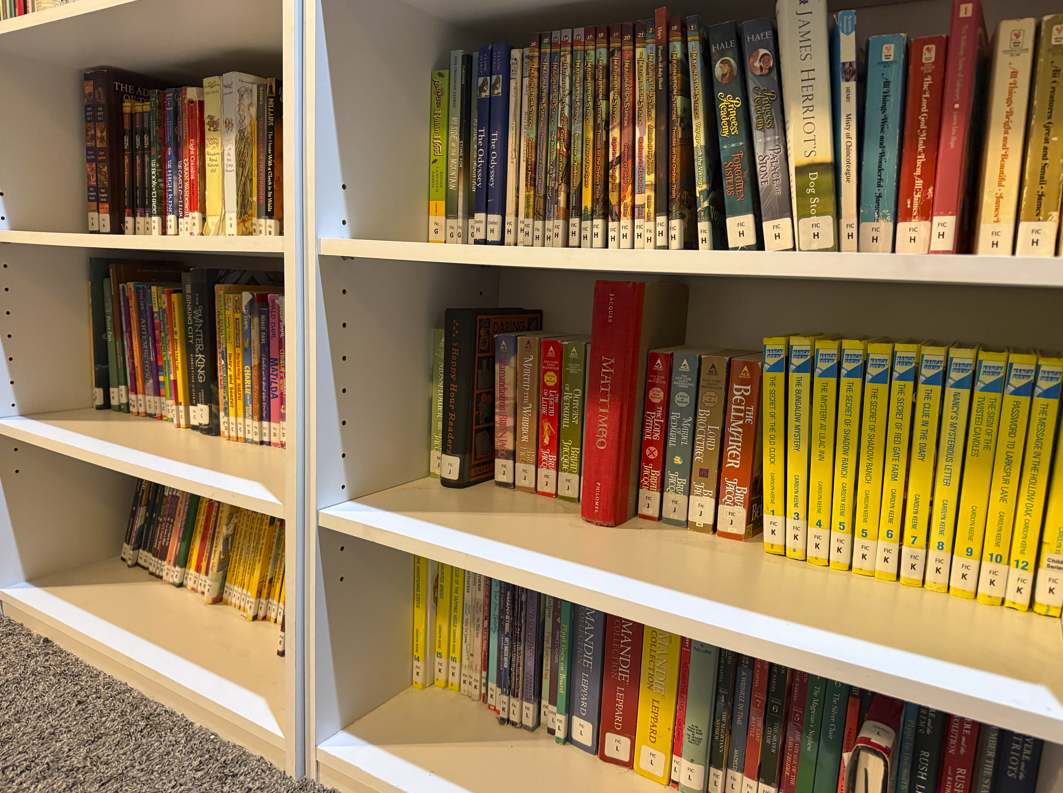
All of our chapter books live in one area of the house on low shelves. Kid height. Grab-and-go accessible.
Yes, this means my toddler pulls them off the shelves sometimes. Yes, it creates the occasional pile on the floor. But here’s the trade-off I made: a toddler making a mess of books is a problem I can live with. A house full of kids who don’t read because reaching a book requires a parent’s involvement is a problem I cannot.
The goal isn’t a picture-perfect shelf. The goal is kids who browse.
When books are accessible, kids pick them up randomly. They flip through them out of boredom. They discover a series they didn’t know they wanted. That only happens when the books are there — in reach, in sight, easy.
The good news is that when you have a real system (step 2), even the toddler shelf-clearing situation gets manageable fast.
Step 2: Label the Spines by Author’s Last Name — Just the First Letter
This is the heart of the whole thing, and it’s simpler than it sounds.
I printed out a sheet of small square labels — one sheet per letter of the alphabet. Each label says FIC in small text at the top (for fiction) and then the letter, big and bold. I used 1″x1″ square label sheets — linked here, which fit a ton of labels per page and work perfectly on book spines.
I made my own template in Word, and honestly, you’re welcome to just use mine. Click the download button below, open it, print it on your label sheets, and you’re done. No design work required. Just use “find and replace” to change the A to other letters.
Then I put a clear protective label over each sticker so it doesn’t peel off over time. These clear cover labels are the ones I use — they save the labels from the wear and tear of little hands pulling books on and off shelves constantly.
Here’s the process: when a book comes into our house, I find the author’s last name, grab the right letter sticker from my tub, put it on the spine, cover it with a clear sticker, and shelve it. That’s it. Books are organized with all the A-authors together, B-authors together, and so on.
Here’s what I do NOT do: fully alphabetize.
My little organizing heart would genuinely love a library so precise I could locate any book in under thirty seconds. But full alphabetization creates a system where only the person who built it can maintain it. Every time someone pulls a book out, it has to go back in exactly the right spot — and that’s too hard for a kid. It becomes a parent job, which means it stops happening, which means the system falls apart.
First letter only means any child who knows the alphabet can help put books away. In our house, this has the bonus side effect of turning book cleanup into letter practice for younger kids. I’m not going to pretend I planned that, but I will absolutely take credit for it.
And honestly? We’re not an actual library with thousands of books. We’re a homeschool family with hundreds. I can find any book we own in under five minutes just knowing roughly what letter the author starts with. That’s enough.
The secret to making this sustainable: I keep all my stickers in a small tub right at my desk (this size fits everything nicely). When a new book comes in — from an order, from a trip to Half Price Books, from a grandparent — I can label it in about sixty seconds without hunting down supplies. If I had to stop and print labels every time we got a new book, I would give up. The whole system only works because the supplies are already there.
Step 3 (Optional): Keep a Running List
I want to be upfront: this step takes more time, and it is completely optional. If the idea of it makes you tired, skip it and don’t look back. Steps 1 and 2 are the actual system. This is the icing.
That said — I keep a Google Doc with the author and title of every chapter book we own, and I use it more than I expected to.
The most common scenario: I’m standing in Half Price Books, I see a book that looks familiar, and I genuinely cannot remember if we own it. I open my doc, search the title, and know in ten seconds whether to buy it.
The other scenario: a friend asks what her eight-year-old should read next. Instead of trying to recall everything off the top of my head, I open the doc and actually browse what my kids have loved. It becomes an easy recommendation list.
But if keeping a record of every book you own sounds like a chore that will haunt you — skip it. A well-labeled shelf is already a win.
The One-Time Setup
If you’re starting from scratch, here’s the real talk: the initial labeling takes time. Put on a podcast, grab a cup of coffee, and set aside an afternoon. Once every book has a sticker, the ongoing maintenance is almost nothing — sixty seconds per new book.
That’s the goal with any organizing system, isn’t it? Heavy lift once, then coast.
A home full of books is a gift. I genuinely believe that. But a home full of books nobody can find — or nobody bothers to reach for — isn’t serving anyone. These three steps (or honestly, just the first two) turn your collection into something your kids will actually use.
And if a toddler reorganizes a shelf every now and then? That just means they’re surrounded by books. There are worse problems.