
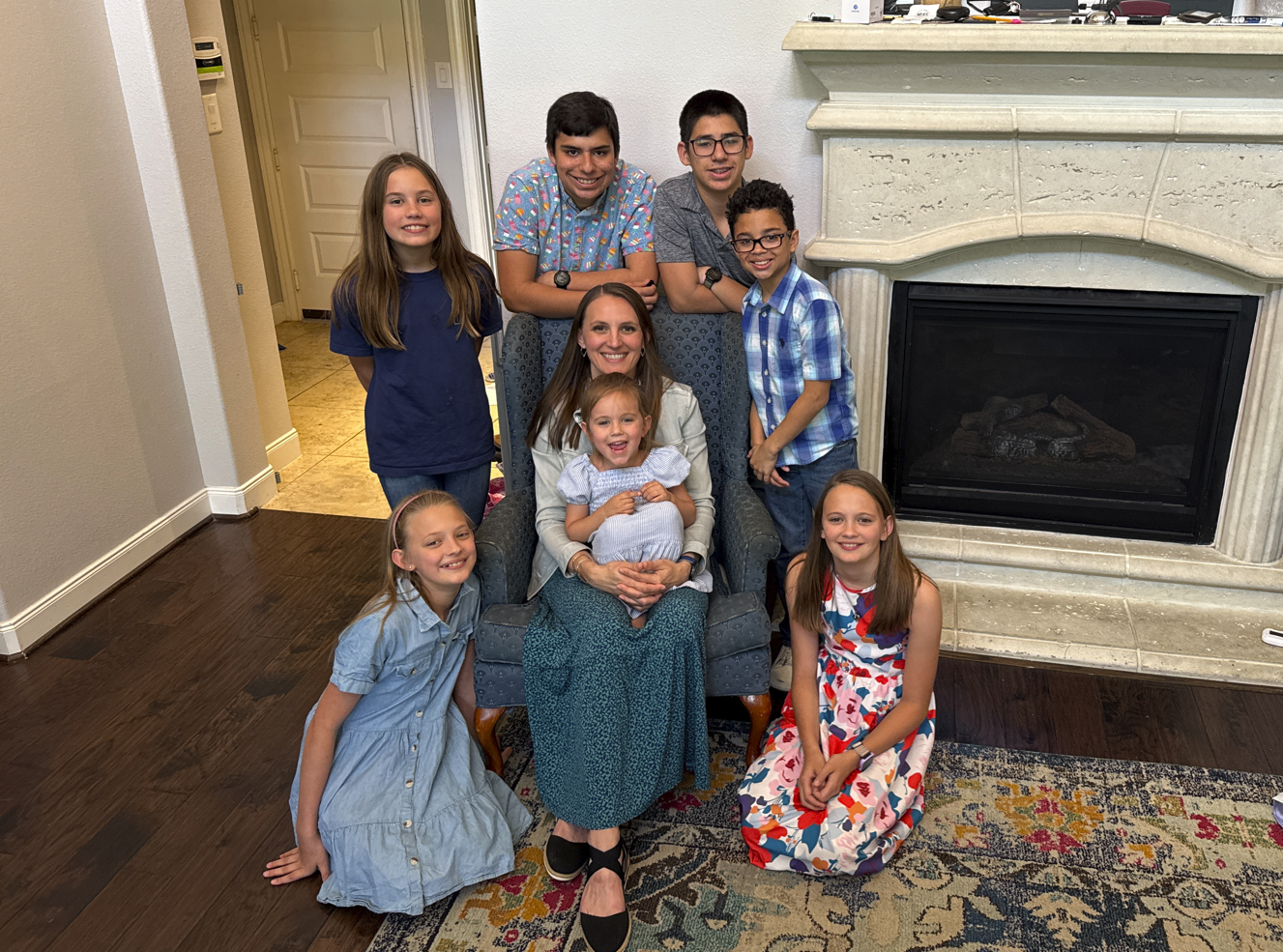
If you’ve stumbled onto this blog for the first time – welcome! Before I start sharing schedules and curriculum reviews and AI hacks for lesson planning, I want to tell you why I do any of this in the first place. Because if you don’t know why our family homeschools, nothing else I write here will make much sense.
And I’m going to give you the real answer. Not the pretty one.
It started before we even had kids
My husband and I decided we would either homeschool or send our kids to private school before we were ever married — back when we were dating and talking about the kind of family we wanted to build. I went to private school my whole life. He was homeschooled from fourth grade on. We both came out of those experiences believing the same thing: that it’s the parent’s job to train their children in the love and admonition of the Lord, and that means grounding them in a Christian education from the start.
So the plan was always Christian school or homeschool. Simple enough, right?
Except then we became parents. And we became parents in the way nobody plans for — we became foster parents first. And foster kids, legally, have to attend public school. So our oldest two started their education at the local public school, but we brought them home to homeschool after their adoption was finalized.
In public school, my son received accommodations for some of his learning differences, but even so, it just wasn’t working. I’ll be honest — hearing my son explain how he got to opt out of second grade math at school by playing on an iPad while his classmates got instruction was an extremely discouraging moment. He was still falling through the cracks because no system, no matter how well-intentioned, can care about your specific child the way a parent does.
So, we started over completely when we brought him home, which put him behind grade level on paper. Best decision we’ve ever made. Math is now one of his strongest subjects — not because I’m a world-class math teacher, but because I cared enough to try curriculum after curriculum until something clicked. That’s something even the best classroom teacher cannot do for every student in their class. There are just too many of them and only one teacher.
The reasons I don’t always lead with
Here’s what I’ve learned people assume when they hear “I homeschool seven kids.”
They assume I’m extraordinarily patient. I always laugh at this one. I am not patient by nature — at all. Homeschooling has simply given me a relentless opportunity to grow in patience, and the Lord loves to grow us through adversity, so I’ve had a lot of practice. I might be more patient now than I was ten years ago. But I didn’t start here, and patience is not a prerequisite for this life.
They also assume somehow my husband and I felt an abnormal “calling” to homeschool. The reality is we believe what Luke 6 tells us – that every student will be like their teacher. As a parent, my goal is to raise my children to imitate me as I imitate Christ. If I send them to a public school they would be imitating their teachers, very few of which are likely to be believers (and are not allowed to share their faith at work even if they are). So, we didn’t feel “called” specifically to homeschool but knew we’re responsible to God for the influences on our children. While the conviction was always there, the practicalities were messier. I always imagined my kids in private school. Then I had five kids school-aged at the same time and did the math. Private school tuition for five kids is not a number most families can absorb. Homeschooling wasn’t just our conviction — it became our only real option. And you know what? God has a way of using our limitations to confirm our direction.
They assume we school like a classroom does — same grade, same pace, every subject moving in lockstep because that’s what school looks like. And I understand why they think that. It’s the only model most of us grew up with.
But one of the things I love most about homeschooling is that we don’t have to do it that way. Each of my kids moves at their own pace in every subject, independently of each other and independently of their age. One of our boys wasn’t ready to hold a pencil at five. His occupational therapist was clear: his muscles simply weren’t there yet. In a traditional classroom that would have been a problem, because kindergarten doesn’t wait. At home, we just learned about letters before we learned to write them. We decoupled two things that don’t actually have to happen simultaneously. Problem solved, crisis avoided, kid’s confidence intact.
But it works the other direction too. If a child is reading three grades ahead, we don’t make them wait for their age to catch up to their ability. We just keep going. There’s no artificial ceiling, and there’s no artificial floor. Every child in our house is working at exactly the level they’re actually at — and that looks different for every single one of them.
But here’s the real reason. The one underneath all the others.
The most important and rewarding part of homeschooling — the thing that keeps me doing this through the hard seasons, and friend, there have been hard seasons — is watching my children grow in their love of the Lord and their understanding of the world He made.
How God gave us a world that makes sense. How math, art and music all tell us something about the God we serve. How history shows us His purposes unfolding over centuries. How science reveals a world of order that makes technology possible. How there is a true standard of beauty, and it points somewhere.
My kids aren’t walking around singing hymns all day. I want to be clear about that. But they see the connections. They understand that what they’re learning isn’t a collection of disconnected subjects — it’s a unified picture of a God who created an ordered, beautiful, purposeful world and invited us to study it for His glory.
That’s what I’m after. Everything else — the schedules, the curriculum choices, the AI tools, the grading hacks — those are just the machinery that makes this possible.
The goal is kids who know what they believe and why the world makes sense because of it.
So who is this blog for?
It’s for the mom who believes something similar but can’t figure out how to make it work with her actual life. The one who works full time. The one whose kids have learning differences. The one who always assumed she’d do private school until she did the math. The one who doesn’t feel patient enough or organized enough or qualified enough.
I’m a senior leader at a tech company, a pastor’s wife, a church planter, and a homeschool mom of seven kids ranging from four to seventeen. I am not doing this perfectly. But I am doing it, and I can show you how I do it.
Stick around. Every year really does get better.