
Here’s the thing not many people know: I’ve never actually taught kindergarten before.
My sister did.
She was a kindergarten teacher at a university model school — two days a week there, and for years she came to my house the other three days to teach my kids. While I was logging years in homeschool math, history, and science, she was the one who had kindergarten and language arts handled. I watched, I learned, I absorbed much of what she did — but she was the one at the table.
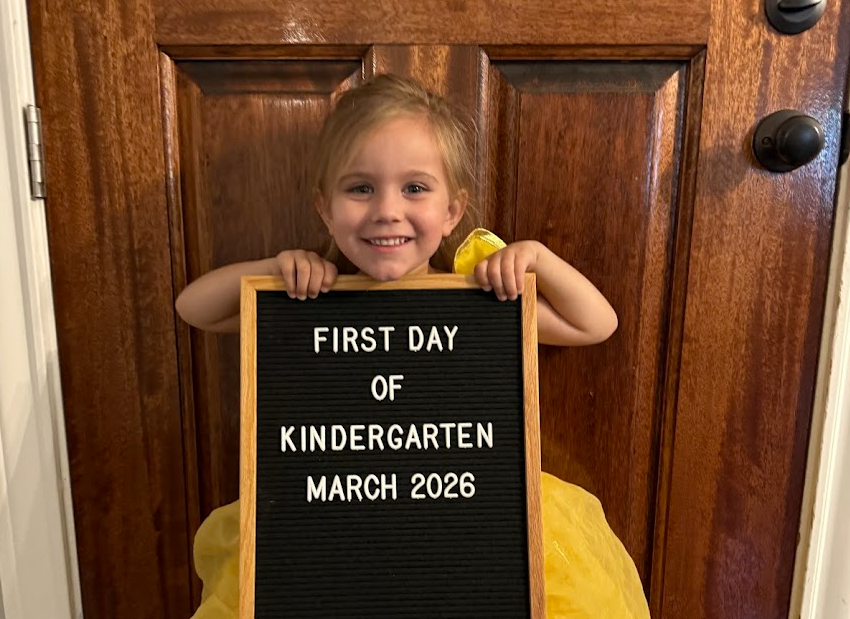
So when our youngest, Molly, started begging — and I mean begging — to do school just like her brothers and sisters, I found myself in an unexpected position: veteran homeschool mom, seven kids in, teaching kindergarten for the first time.
I think there’s something kind of wonderful about that. No matter how experienced we get, there’s always a next thing. A first time. A season that requires us to learn something new.
Here’s how I’m approaching it — leaning hard on what I’ve watched my sister do, adjusting it for our real life, and giving myself grace for the parts I’m figuring out as I go.
1. She Started at Four — Because She Was Ready
Molly started kindergarten in March. She is currently four years old.
If you homeschool and you have a youngest child, you probably already know why: she was watching six other people do school every single day, and she wanted in. It’s one of the sweetest things about large family homeschooling — school looks like fun from the outside. The younger ones see workbooks and flashcards and read-alouds and think, that’s what everyone is doing, why not me?
But I didn’t just say yes because she asked. All About Learning Press — the publisher behind All About Reading and All About Math — has readiness checklists for their reading program. I went through the checklist with Molly and she passed. She had the fine print awareness, the attention span, and the phonemic awareness to start.
So we started. Early, intentionally, and without pressure.
There was also a strategic reason. I knew going in that my work schedule wouldn’t give Molly’s kindergarten the same daily attention I’d seen my sister give. So I figured: if I start early, we can go slow — and still finish on time. Starting in March built a cushion for the busy weeks, the travel weeks, the weeks where work just takes over. I now have two years to get Kindergarten done.
2. I Switched Math Curricula — and I’m More Excited About It Than She Is
We are a Saxon Math family. My older kids use it, it works, and I have no plans to change that. It. Works. 100%.
But for Molly, I’m trying something new: All About Math from All About Learning Press.
We’ve used All About Reading for years, and I trust this publisher completely. Their programs are thorough, interactive, and genuinely well-designed. When they released a math curriculum, I paid attention.
All About Math is heavy on games and hands-on activities, lighter on workbook pages. For a four-year-old who learns by doing and moving, that matters. I wanted math to feel like play at this stage — not like sitting still and filling in blanks. My sister always said the best kindergarten math is interactive, and I’m finally in a position to test that myself.
So far: she loves it. Good enough for me. I’ll definitely post a review after we finish the first level.
3. Her Sisters Are Her Best Teachers (On the Days I Can’t Be)
On my good days, I sit with Molly and walk her through her lessons myself. On my crazy work days — the ones where I have to leave earlier than normal — I hand it off.
Emma (9), Jacqueline (11), and Reagan (11) take turns doing Molly’s reading flashcards with her. They walk her through the number chart. They sit beside her and cheer when she gets something right in a way that only a big sister can.
Every weekday, a sibling also reads Molly a Bible story. We use The Biggest Story Bible Storybook — and honestly, they both always enjoy it. Molly gets Scripture read to her by someone she loves and looks up to, and whoever is reading gets to be her teacher for those few minutes.
I used to feel guilty about this — like I was outsourcing something I should be doing myself. But I’ve watched what happens when a nine-year-old teaches a four-year-old something, and I’ve stopped feeling guilty.
Molly loves learning from her sisters. And her sisters are building patience, communication skills, and confidence they don’t even realize they’re building.
My sister never had to teach that way — she had my kids’ full attention and was able to focus on teaching. I’m doing it differently because my life is different. And that’s okay.
4. Once a Week, She Explores the World With Her Aunt
My sister may not be at my kitchen table three days a week anymore — but she’s not out of the picture either.
She has a daughter six months younger than Molly. So she did what any retired kindergarten teacher with a preschooler and a niece the same age would do: she built them a curriculum.
She calls it World Discovery. Once a week, Molly and her cousin will spend a morning together exploring the world through picture books and hands-on activities. My sister chose books she loves — real, time-tested picture books — and then used Pinterest to find an activity that pairs with each one. Some activities are pure fun. Some teach a science concept. Some just help a four-year-old understand how the world works.
A few of my favorites from her lineup:
The Story About Ping by Marjorie Flack → a “will it float?” experiment. Simple, hands-on, and it introduces buoyancy without ever using that word.
How to Make an Apple Pie and See the World by Marjorie Priceman → tape each ingredient to its spot on a world map, then make an apple pie. Geography and baking in one morning.
The Little Red Hen by Paul Galdone → make bread from scratch. A life skill, a lesson in work ethic, and a classic story all in one afternoon.
The Tale of Peter Rabbit by Beatrix Potter → a plant science experiment. What do seeds need to grow? They find out.
Feel free to take a look at some of what we’re doing this year.
Technically, some of this is PreK content — Molly is four, after all. But since we started kindergarten early, we’re blending the two seasons comfortably. World Discovery doesn’t appear on any scope and sequence. It doesn’t produce measurable output. But it is giving Molly a sense of wonder about the world around her, and I’d argue that’s one of the most important things early education can do.
Not everyone has a retired kindergarten teacher for a sister — I know how lucky I am. But if you have a grandparent, aunt, or co-op friend who wants to be involved and doesn’t know how, this is a beautiful model to share with them. Pick a book. Find an activity on Pinterest. Show up once a week. That’s it. It can be once a week or once a month, do what works for you.
5. We Do Less — and She’s Learning Enough
Here’s the most honest thing I can tell you: Molly’s formal school time takes about 45 minutes a day most days. Some days less (when we only have time for Math OR Reading instead of both).
My sister would probably tell you she did more than that with my older kids. And she did. But she was a professional with years of classroom experience and a dedicated schedule. I’m a full-time working mom juggling six other kids and a church plant.
So I’ve had to get honest about what kindergarten actually looks like in my real life — not the ideal version, not the version I watched from the sidelines for years, but the version I can actually do. Do I sometimes wish I could drop all my responsibilities to do fun Kindergarten activities? Sure. But then I remember that right now this is God’s plan for our family and his plan is always the BEST plan.
And here’s what I’ve learned: fifteen minutes each of intentional phonics and math, plus sisters doing flashcards on the hard days, plus one morning a week of World Discovery with her aunt and cousin, plus being read to every night in a home full of words and curiosity?
That is a kindergarten education. Is it the ideal? Not really. Is it enough? Yes. And then I’ll figure out what 1st grade looks like with the resources I have next year. I’m not going to stress about it now.
There’s Always a First Time
I’ve been thinking about what it means to do something for the first time — even when you feel like you should already have it together.
Jesus says in Matthew 11:29–30: “Take my yoke upon you, and learn from me, for I am gentle and lowly in heart, and you will find rest for your souls. For my yoke is easy, and my burden is light.”
I spent years watching my sister carry the kindergarten yoke and thinking, one day I’ll know how to do that. Now I’m the one at the table, and I’ve realized: it’s lighter than I expected. Not because it’s easy, but because I’m not carrying it alone.
I have a sister who poured into me. I have daughters who show up for Molly on my hard days. I have a God who never asks me to do anything without also providing what I need to do it.
You can be experienced and still be a beginner at something. You can be a veteran homeschool mom and still have firsts ahead of you. That’s not a failure — that’s just a life that keeps growing.
For the Mom Starting Kindergarten This Year
Whether this is your first or your seventh — a few things I’d pass on:
Use a readiness checklist before you start. Many curriculums provide free ones online — they’ll tell you if your child is genuinely ready or if you’re both better off waiting a few months. Don’t get caught up on when an official school year “should” start. Adjust as needed – that’s the point of homeschooling.
Plan around your actual life. If your schedule is tight, start earlier and go slower. Give yourself the cushion before you need it. Believe me – your future self will thank you.
Let the people who love your child be part of their education. Older siblings, a retired-teacher aunt, a grandparent who loves to read aloud — you’re not the only one who can teach your child. You’re just the one holding it all together.
And give yourself permission to be a beginner. Even if you’ve done this for years, there’s always something new ahead. That’s not weakness — that’s how we keep growing right alongside our kids.