
This post contains affiliate links, which means I may earn a small commission if you purchase through my links — at no extra cost to you. I only recommend things I’ve actually used with my own kids.
The country of Alaska.
I blinked. I smiled. I said something calm like, “Oh, that’s actually a state, honey — let’s look it up.” And then I walked into the kitchen, stood at the counter, and had a quiet internal crisis.
Because in that moment, I realized something that no homeschool mom ever wants to realize:
I had never taught my kids US Geography.
Not a little. Not “we haven’t covered it recently.” I mean at all. These kids — some of whom were in 5th grade — could not reliably tell you where any state was on a map (outside of Texas of course). They did not know Alaska was a state. They thought it might be a country. A whole country.
I am a homeschool mom of seven children and I had raised tiny Americans who did not know their own country’s geography.
Here Comes the Spiral
If you’ve been homeschooling for more than five minutes, you know what happened next. My brain did what homeschool mom brains do: it went full spiral.
I know so many moms who do classical education. Their kids have memorized all fifty states and capitals since second grade. There’s a song. Why didn’t we do the song? We should have done the song. We should have been doing state projects. Lapbooks. Notebooking pages. We should have—
You know this voice. Maybe you’ve heard it too.
It’s the voice that takes one discovered gap and uses it as evidence for your entire prosecution. One missing subject becomes proof that you are failing your children, that you made the wrong choice, that some other mom is doing this so much better than you are.
I let myself spiral for a few minutes. And then — by the grace of God and a lot of hard-won practice — I stopped.
A Word About Stopping the Spiral
Here’s what I’ve learned after ten-plus years of homeschooling seven kids while working full-time: the spiral is a liar.
One gap does not mean everything is a gap. One missed subject does not erase everything you have taught. My kids know a lot. We’ve covered history, literature, math, science, writing, and more — and we’ve done it while navigating two working parents, church planting, and the beautiful chaos of a big family.
We skipped US Geography. That’s real. But it’s not a verdict. It’s just a gap. And here’s the thing about gaps:
You can fill them. That’s the whole point of homeschooling.
My kids hadn’t graduated. We hadn’t run out of time. We’d just run out of bandwidth in one area — and now that I knew, I could do something about it.
So I stopped the spiral and made a plan.
What I Actually Did About It
I did the thing that strikes fear into the hearts of my children every June: I made it a summer school project.
(They’re fine. They survived. Mostly.)
Here’s my philosophy on summer school: we use summer to fill gaps and keep math from going stale — but I keep the workload way lighter than the school year so it still feels like a break. Summer is for flexibility. We’re not running a year-round academy over here. We’re just making sure certain things don’t fall off the cliff entirely.
For US Geography, I ordered three things:
- Elementary U.S. Geography & Social Studies Teacher Guide — this was our backbone. It’s packed with workbook pages, activities, and projects organized by state. Fair warning: there is more in this guide than any reasonable family will actually complete in one summer. That is fine. That is by design. Pick what works for your summer.
- Passport to America — a companion reader that goes state by state. Readable, engaging, not dry. My kids actually liked it.
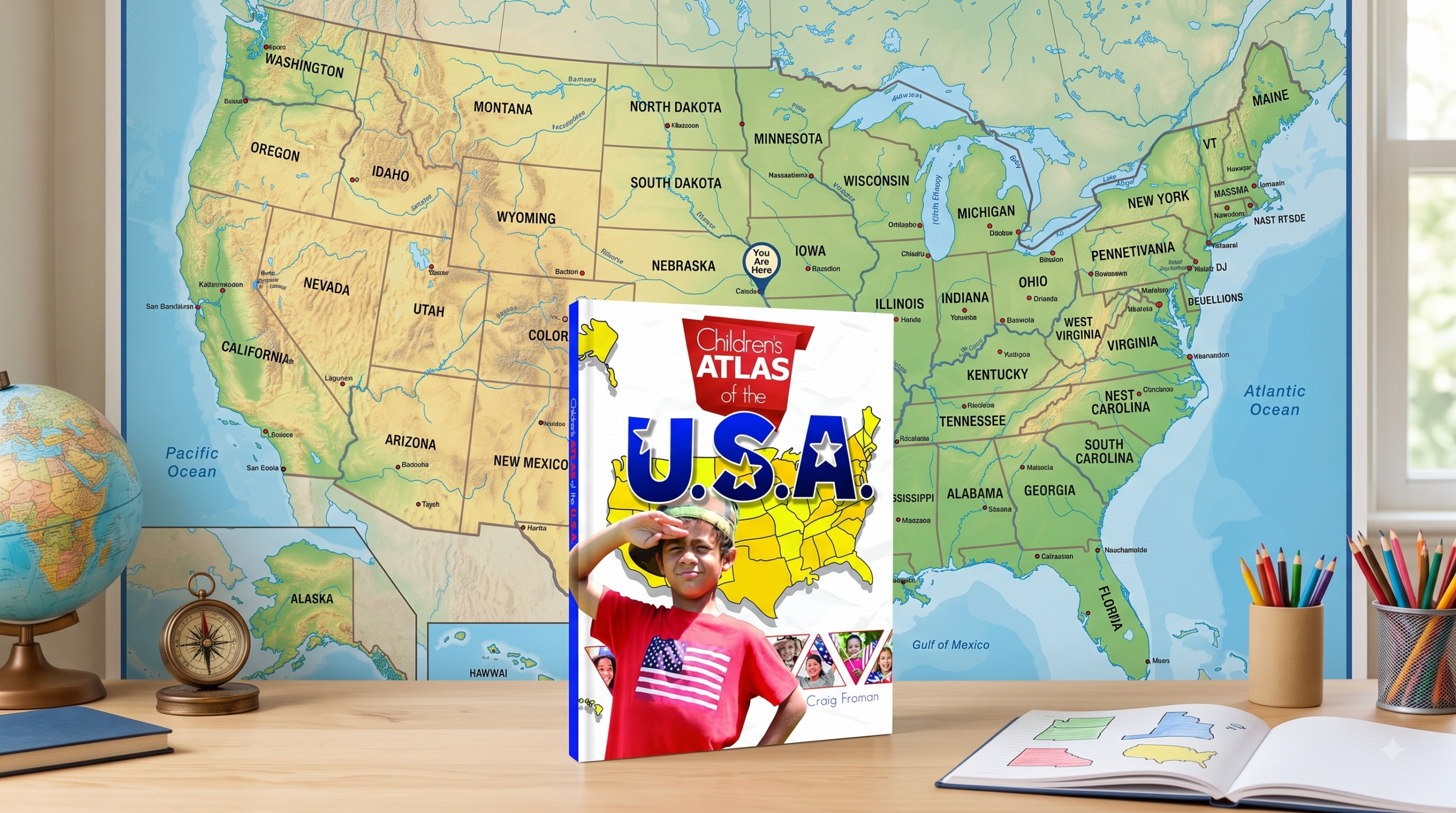
- Children’s Atlas of the U.S.A. — maps, maps, maps. Because finding the state on an actual map was non-negotiable for us.
Our summer routine was simple: three states per week. That’s it. Three states, every week, all summer.
On our busy weeks — and summer with seven kids is somehow always busy — we did the bare minimum. A few workbook pages. Find the state on the map. Move on. Done.
On our slower weeks, we did a little more. A project here, a fun fact deep-dive there. Nothing elaborate.
What “Filled” Actually Looks Like
I want to be honest with you, because this is that kind of blog.
Were my kids geography experts by August? No. Are they geography experts now, two years later? Also no. I’m not going to pretend that one summer of three-states-a-week turned my kids into cartographers.
What it did was give them a foundation. They know the states. They know roughly where they are. They’re not going to embarrass themselves — or me — if someone asks them to point to Idaho on a map. That gap that had me spiraling in the kitchen? Filled. Not perfectly, not permanently, but filled enough to build on.
And here’s what I’ve actually done to make sure geography doesn’t get away from me again: my two high schoolers are taking Geography this year as a proper course. Now that we’ve got the basics in place, they have something to build on. That’s the goal — not perfection in fifth grade, but a foundation that makes the next thing possible.
The only state that has never required any remediation in this house, by the way, is Texas. My children have always known where Texas is. They were born knowing. It is, after all, the best state — and they will defend that position confidently, now that they actually know where all the other states are too.
If You’re In the Spiral Right Now
If you’re reading this because you just discovered your own version of “the country of Alaska” — your kid doesn’t know cursive, or you realize you’ve never formally covered grammar, or you somehow skipped an entire era of history — I want you to hear this:
You are not failing. You have a gap.
Gaps are fixable. Shame is not a curriculum.
Take a breath, stop the spiral, and make a plan. Summer is a great time to fill things in. So is a spare Tuesday. So is any day you decide to pick it back up.
That’s the beauty of homeschooling: you get to notice the gaps and do something about them. Public school moves on whether the gap gets filled or not. You don’t have to.
Now go find a map.
Have you ever discovered a subject you completely forgot to teach? Tell me about it in the comments — I promise you’ll feel better after you share it.
Resources mentioned in this post: