
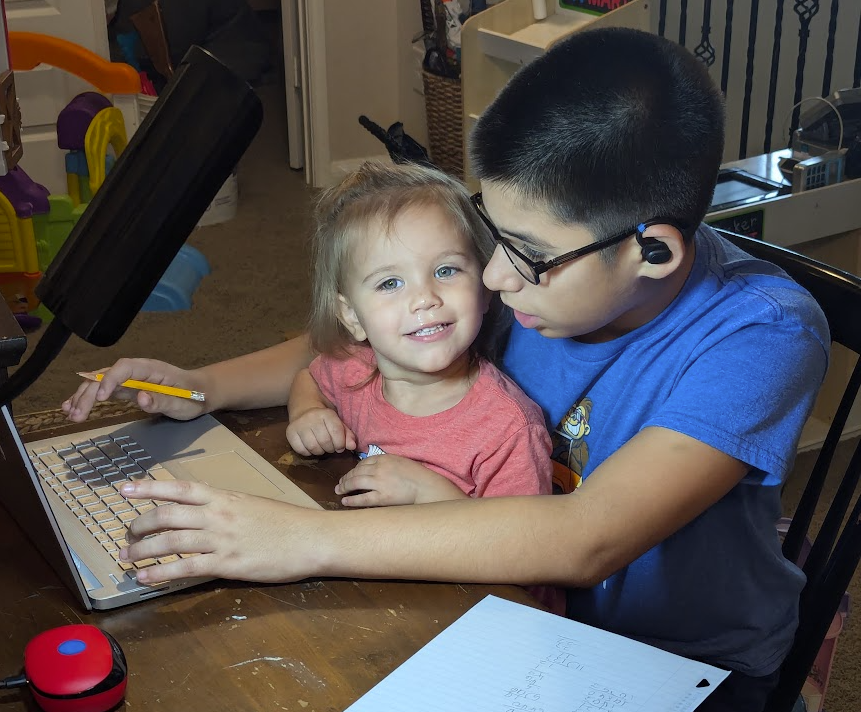
I have a 17-year-old. But I’ve only been homeschooling for 10 years — because our oldest came to us at age five through foster care, and foster kids go to public school. We brought him home to homeschool after his adoption was finalized.
So when I say 10 years, I mean 10 years of curriculum decisions and crying to my husband and Saturday grading sessions and moments where I wasn’t sure how we’d keep going as our kids got older and their education got more complex — and moments where I thought there is absolutely nothing else I would rather be doing with my life.
Here’s what I know now that I didn’t know then.
You are allowed to throw out the curriculum
This took me longer to learn than it should have.
When you spend real money on a curriculum and commit to it at the start of the year, there’s a voice in your head that says you have to finish it. You said you would. You paid for it. Quitting feels like failure.
It’s not failure. It’s information.
If a curriculum isn’t working — if your kid is miserable, if the lessons aren’t sticking, if you dread opening the book every morning — that curriculum is not the right fit for that child right now. Switching isn’t giving up. Switching is doing your job.
And don’t spiral about being “behind.” Finding the curriculum your kid will actually learn from means the learning will actually stick. A child who finishes half a book and genuinely understands it is ahead of a child who completes every page and retains nothing. There is also always summer. We have finished more than one school year’s worth of material in June, and I have zero regrets about it.
Homeschooling doesn’t mean mom teaches everything
Back when LJ and I were dating and dreaming about our future family, I pictured myself as the teacher of record for every subject, every day. By the time we actually had kids I knew that wasn’t realistic — but I don’t think I fully appreciated just how much of a village this would become.
Over the years our kids have been taught by my husband, my mom, my sister, a friend who comes over weekly, online classes that are self-paced, live online classes with real teachers, and an in-person co-op. I am the architect of their education — I plan it, I oversee it, I fill in the gaps — but I am not the only teacher in this village. And that’s not a compromise. That’s a feature.
The other thing I assumed was that once I found what worked, I could rinse and repeat across all seven kids. Find the math curriculum, use it forever, done. What I’ve actually found is that each child is different enough that what clicks for one doesn’t always click for another. This means I am constantly adjusting, constantly learning, constantly finding new approaches. Ten years in and I am still figuring things out. That’s not a failure of the system. That’s just parenting.
Your homeschool doesn’t have to look like anyone else’s
For a while I listened to podcasts and read blogs and became completely enchanted by the idea of a morning basket — starting the day with beautiful picture books, poetry, hymns, and unhurried family time before the real work began. It sounded wonderful. It is wonderful, for the families it works for.
It does not work for us.
If we are going to get math done — and math will be done — it has to be first. “Math starts at 8” is something my kids have heard approximately one million times, delivered by me walking through the house at 7:45 in the morning finding children still in pajamas.
I grieved the slow morning for a while. Then I found my own version of it. As my kids have gotten older and started staying up later, I’ve begun reading classics aloud to them in the evenings and asking literature questions that spark real conversations. It’s not a morning basket. It’s a nighttime one. And it turns out it fits our family perfectly.
Stop trying to replicate someone else’s homeschool. Find your version of the beautiful thing.
Your kids will surprise you
I can’t tell you exactly when it happened, but at some point I looked up and realized that any two of my kids can be put in a room together and they know how to be together. They play. They talk. They hang out. My girls are completely comfortable with their teenage brothers. The older ones love to help teach the youngest. Each child has a unique and genuinely deep relationship with each sibling.
I have friends who didn’t get close to a sibling until they were both adults. I love that my kids aren’t waiting that long.
I can’t promise homeschooling causes this. But I can tell you that the sheer amount of time my kids spend around each other has given these relationships room to grow in a way I didn’t fully anticipate when we started. It’s one of my favorite things about this life.
The subjects you love will be easier to teach — and harder
The subjects you naturally love will be easier to teach because your genuine enthusiasm is contagious. Kids can tell when you actually find something interesting. It comes through.
They will also be harder to teach, because that one child who has absolutely no interest in your favorite subject will baffle you completely.
Math is my thing. Math makes sense. Math is consistent. You can always check your work and know if you got it right. It is, objectively, wonderful. I have been tempted — and may have occasionally given in to the temptation — to say some version of this out loud to a child who did not share my enthusiasm. We are working on that.
But I’ve also learned the flip side. I have always been a STEM girl. Keep your writing away from me, please. Then I discovered I have a son who loves to write — really loves it — and in trying to develop that gift I’ve had to learn far more about writing than I ever expected. And it’s hard not to start loving something your child does beautifully. He has made me a better teacher and, quietly, a better writer. I did not see that coming in year one.
Every homeschool mom has cried to her spouse that she’s ruining her kids’ education
Every single one. If she says otherwise she is either lying or hasn’t been doing it long enough yet.
When a child hits a wall and you cannot seem to help them through it, you feel like you’re failing them. When you pick the wrong curriculum, you feel like you’re failing them. When you get sick and no school gets done for three days, you feel like you’re failing them.
My husband has pulled me back from this brink more times than I can count. His move is to remind me to look at the 10,000 foot view. Kids hit walls in public school all the time — and sometimes stay there, because the teacher can’t make the whole class wait for one student. Curricula in public school are sometimes too hard or too easy, but the state controls that so a teacher can’t just throw it out and try something new. Public school teachers get sick too — and we all know what that means for what actually gets done that day.
It’s easy to see your problems as catastrophic because this is your child’s education and you want it to be the best. But here’s what my husband keeps reminding me, and what I want to remind you:
Your problems aren’t unique. Your ability to choose a different path is.
Sometimes that means changing what you’re doing. Sometimes it means taking a breath and pressing on. But either way, you’re upset because you care — and that care is exactly what makes you the right person to be in charge of your child’s education.
No one cares like you care. And that is enough.