
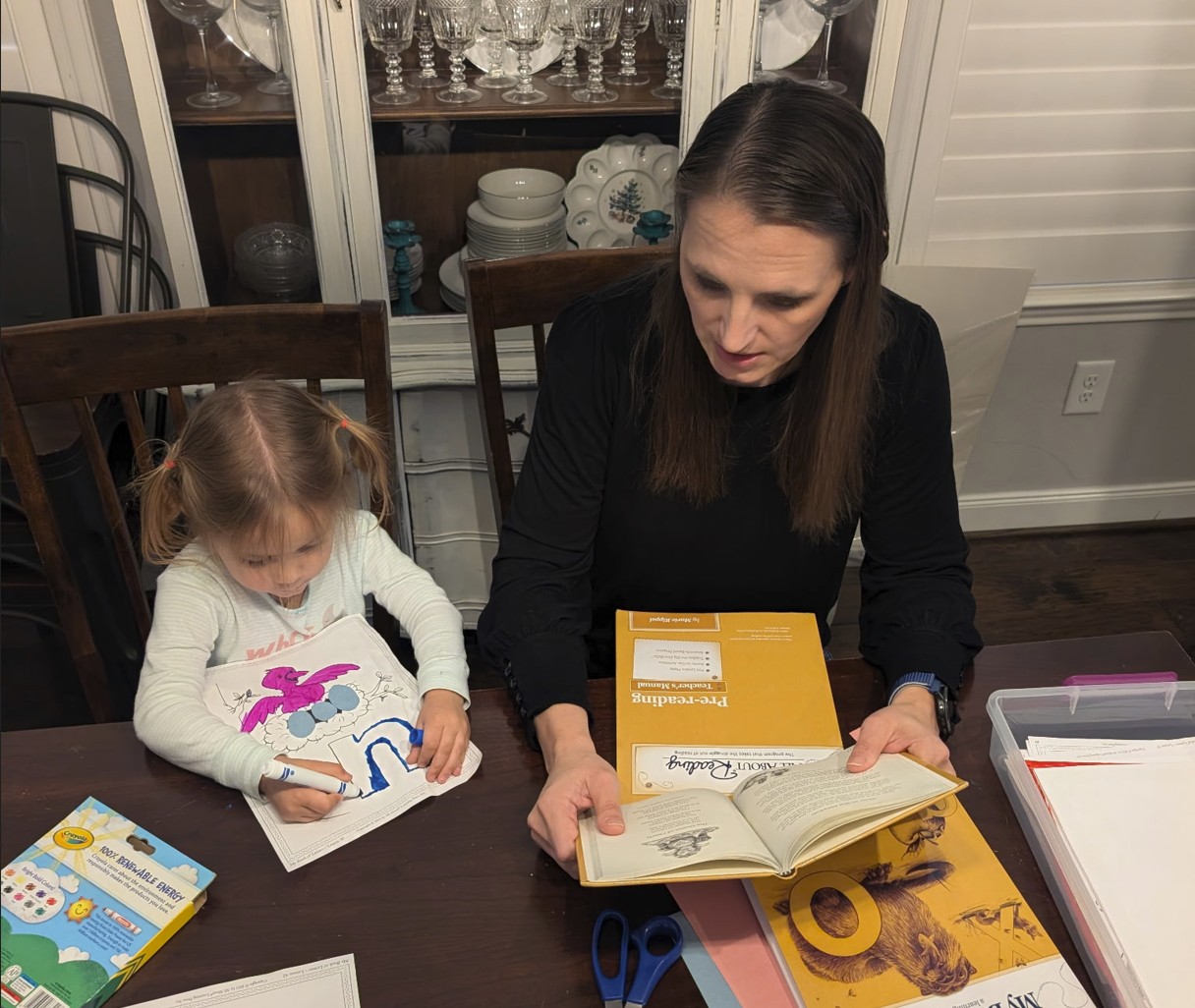
When people find out I homeschool seven kids while working full-time as a Director at a tech company, they usually respond one of two ways. Either they look at me like I’ve just told them I also wrestle alligators on weekends, or they say something like “I don’t know how you do it.”
Honestly? Some days I don’t either.
But here’s what I want to tell you — because I remember being the mom who couldn’t figure out how it was possible, staring at a calendar full of work meetings and little faces and thinking there was simply no way to make this work. There is a way. It just probably doesn’t look like what you’re imagining.
First, let me tell you about the dream I had to grieve
When LJ and I were dating and dreaming about our future family, I built up a picture in my mind of what homeschooling would look like if we decided to homeschool. It was beautiful. It involved lots of unhurried time with my children, nature walks, and — I’m just going to say it — handmade historically accurate costumes for every period of history we studied.
I know.
When reality arrived — five kids all at once, a full-time job, and approximately zero spare hours — I had to let that dream go. And I actually cried about it. Not because the costumes were the point, but because the vision behind them was. The unhurried, all-in, nothing-else-on-my-plate version of homeschooling I’d imagined simply wasn’t available to me.
What I’ve built instead isn’t that picture. But it’s real, and it works, and my kids are thriving. And I have learned to trust that somehow THIS is better than my plans ever were because God’s plans are always better and this is what He has for my family in this season.
Every year looks different — and that’s okay
I remember back in 2019, feeling genuinely panicked about how I was going to homeschool multiple kids while working. I couldn’t see a path. Then Covid happened, I started working from home, and suddenly I could teach in the mornings and on my lunch break. Problem (unexpectedly) solved.
This past school year I worked hybrid — half in the office, half at home. That meant math in the mornings during what would have been my commute time, and science on my lunch break. The rest of the subjects were covered by our co-op, my husband, my sister, and a friend who came over to teach a history class at my house.
Next year I’m in the office four days a week. So we’re rebuilding again. More co-op classes, more online options, and I’ll still teach kindergarten to our youngest early in the morning before I leave. We’ll also let subjects bleed into summer when we need to — we just finished last school year’s science at the end of June, and I have zero regrets about that.
Here’s the most freeing thing I can tell you: you don’t have to figure out all twelve years right now. You just have to figure out next year. Your resources will change. Your kids’ needs will change. Your work situation may change. Every year you just solve the puzzle in front of you with the pieces you actually have.
The thing that actually makes it work
If I had to identify the single load-bearing piece of our entire system, it’s my weekend planning block. Every weekend, I go through everything that was done the previous week and plan out the next week of school. It takes a real chunk of time and I definitely sacrifice other things to make room for it. But it’s the reason our weeks run smoothly instead of sideways.
Every one of my kids has a list of exactly what they need to accomplish each day. In the past I printed these on planning sheets and each kid had a clipboard with their name on it (some time I’ll do a post on how that worked). More recently I used AI to build a simple online tool where I load their lessons and they can check them off as they go. Paper or high-tech, the method matters less than the principle behind it: I look at what’s actually on our calendar that week and I am ruthlessly realistic about what we can accomplish. Some weeks we skip science entirely because I know we have too much else going on. The following week we may double up.
A flexible plan executed consistently beats a perfect plan abandoned in week two every single time.
Someone probably needs to be home
This is the practical reality that may be a deal breaker for some people. Unless your kids are older and highly independent, someone needs to be physically present during the school day. For us that has meant grandparents teaching, an aunt coming over several times a week, my husband working from home, a friend who takes a subject, self-paced online classes, live online classes, and in-person co-op. Over the years I’ve tried almost every variation of homeschool support that exists, and at different seasons, different combinations were exactly what we needed.
If you’re looking at your situation and thinking “but I don’t have any of those people” — I hear you. Your solution may not look like mine. What I’ve learned is that when God calls you to something, He tends to provide what you need to do it, even if it doesn’t arrive in the form you expected or on the timeline you preferred. Every year I’ve wondered how we were going to pull it off. Every year it has come together. So, if you’re trying to figure out how to make it work, get creative. Can a grandparent come over and just supervise? Can they go to a friend’s house for a day a week? If you split the teaching and the supervising and tackle them separately, sometimes that enables solutions you may not have thought of before. Start by praying for wisdom and a clear path and be open to unique solutions.
What surprised me most
What I was most afraid of — that my kids wouldn’t get the quality of education they deserved — has turned out to be not as big of a worry in practice.
A few weeks ago I took my kids (well, not the toddler) to see Hamilton. Afterward, as we walked away from the theater, we started unpacking the conflicts in the story — man vs. man, man vs. fate, man vs. God. My preteens. Discussing narrative conflict and theology in the context of a Broadway musical, and enjoying it.
That’s not a test score. That’s not a grade level. That’s a kid who knows how to think, and why it matters, and how it connects to something bigger than themselves. That’s what I was after.
What still surprises me — even though it shouldn’t — is that my kids are, in fact, children. Which means one of them will occasionally spend three hours on math that should take forty-five minutes, leaving no time to play that afternoon – and then completely despair by this cause and effect (even though it may have happened last week too). This is less a homeschooling problem and more a humanity problem, but it does remind me when planning that they are still kids and not a group of co-workers I can expect to always work efficiently.
So can you actually do this?
Maybe. And I say that with genuine respect for the fact that there are real seasons and real circumstances where homeschooling simply isn’t possible. I don’t want to be the person who makes a mom feel guilty for a situation she can’t change.
But I also know that a lot of moms who think it’s impossible haven’t yet explored every option. They’re holding a picture in their head of what homeschooling has to look like — probably someone they know, or something they saw online — and measuring their own life against that image. If it doesn’t match, they assume it can’t work.
What I want you to know is that homeschooling doesn’t have to look like anyone else’s version to count. It doesn’t have to be you teaching every subject. It doesn’t have to happen between 8am and 3pm. It can include co-ops, online classes, grandparents, or a friend who comes over to help. What matters is that it works for your family, in your actual life, with the pieces you actually have.
If you’re in a season where it genuinely isn’t possible right now — that’s okay. But if you’re in a season where you think it’s not sure if it’s possible and maybe you just haven’t found your version yet — I’d encourage you to keep looking. Your version exists. It just might look nothing like the one you imagined.